
Peer Review and Editorial Process
The Riphah Journal of Islamic Thought and Civilization publishes two issues annually, covering the periods of January to June and July to December.
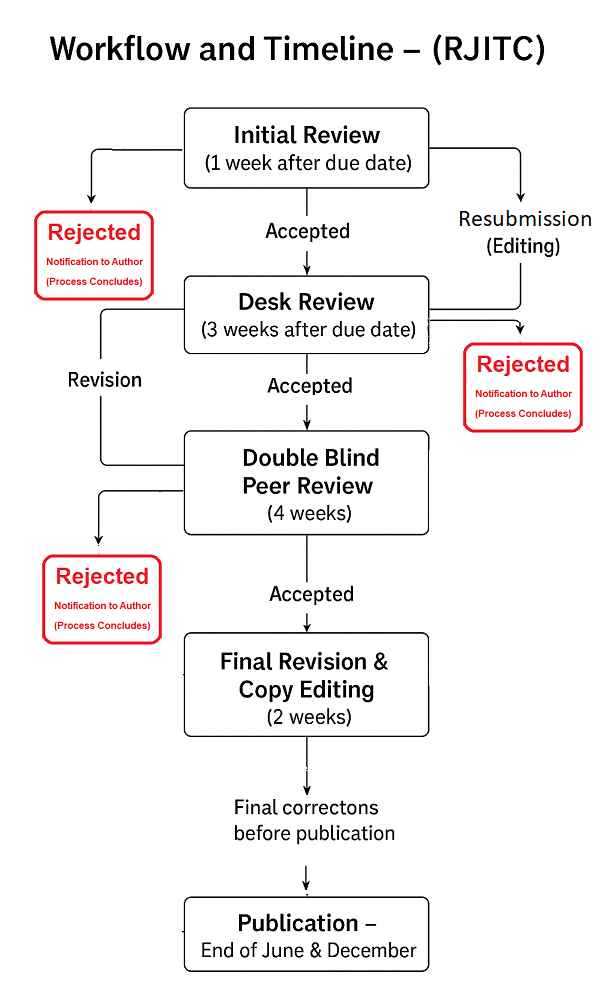
Peer Review Process
All manuscripts submitted to the Riphah Journal of Islamic Thought and Civilization undergo a rigorous double-blind peer review process to ensure academic quality, originality, and adherence to the highest standards of publication ethics.
1. Initial Screening (Editorial Office)
The Managing Editor/Editorial Office conducts a preliminary assessment to determine whether the manuscript falls within the journal's scope and complies with the submission guidelines, formatting requirements, and publication ethics. Manuscripts that do not meet these basic requirements may be returned to the authors for correction or declined at this stage.
2. Editorial Assessment (Associate/Section Editor)
Manuscripts that successfully pass the initial screening are assigned to the Associate/Section Editor, who evaluates their scholarly merit, originality, methodological soundness, relevance to the journal's scope, and suitability for external peer review. The Associate/Section Editor may recommend rejection of manuscripts that do not meet the journal's academic standards.
3. Pre-Review Revision (Associate/Section Editor)
Where minor deficiencies are identified that do not warrant rejection, the Associate/Section Editor may return the manuscript to the author(s) for revision before external peer review. Authors are required to address the editorial comments and resubmit the revised manuscript. The Associate/Section Editor determines whether the revised manuscript is suitable to proceed to external peer review.
4. Selection of Reviewers (Editor)
Based on the recommendation of the Associate/Section Editor, the Editor appoints at least two independent reviewers. Selected reviewers must:
- hold a PhD in the relevant discipline;
- possess recognized expertise and a strong record of scholarly publications in the subject area; and
- have no actual or potential conflict of interest with the authors or the submitted manuscript.
5. Double-Blind Peer Review (Reviewers)
The journal follows a double-blind peer review system in which the identities of both authors and reviewers remain confidential. Reviewers evaluate the manuscript's originality, methodology, academic contribution, clarity of presentation, and ethical compliance, and provide one of the following recommendations:
- Accept;
- Accept with Minor Revisions;
- Major Revisions Required;
- Reject.
6. Editorial Decision (Editor)
The Editor, after considering the recommendations of the Associate/Section Editor and the reviewers' reports, makes the editorial decision. Where reviewers provide conflicting recommendations or additional expertise is required, the Editor may appoint one or more additional reviewers. The Editor is solely responsible for the final editorial decision.
7. Revision and Final Acceptance
Authors are required to submit a revised manuscript together with a detailed response to the reviewers' comments. The revised manuscript is assessed by the Editor, in consultation with the Associate/Section Editor, and, where necessary, may be returned to the original reviewers for further evaluation. Final acceptance is granted by the Editor only after all reviewer comments have been satisfactorily addressed and the manuscript fully complies with the journal's scholarly and ethical standards.
The Editor has overall responsibility for ensuring the integrity, fairness, transparency, and confidentiality of the peer review process. All editorial decisions are made independently, objectively, and free from discrimination or undue influence, in accordance with internationally recognized principles of publication ethics.
* The Journal adheres to a transparent and structured workflow process and timeline. However, this may be affected by procedural hurdles or communication delays with stakeholders. Moreover, the volume of submissions may influence the process, and some papers may be scheduled for publication in a subsequent issue. In such cases, authors will be duly notified in a timely manner


