Barriers to Rehabilitation Among Road Traffic Accident Survivors in Karachi: Clinical Reflections from a Public Sector Setting - Letter to Editor
Abstract
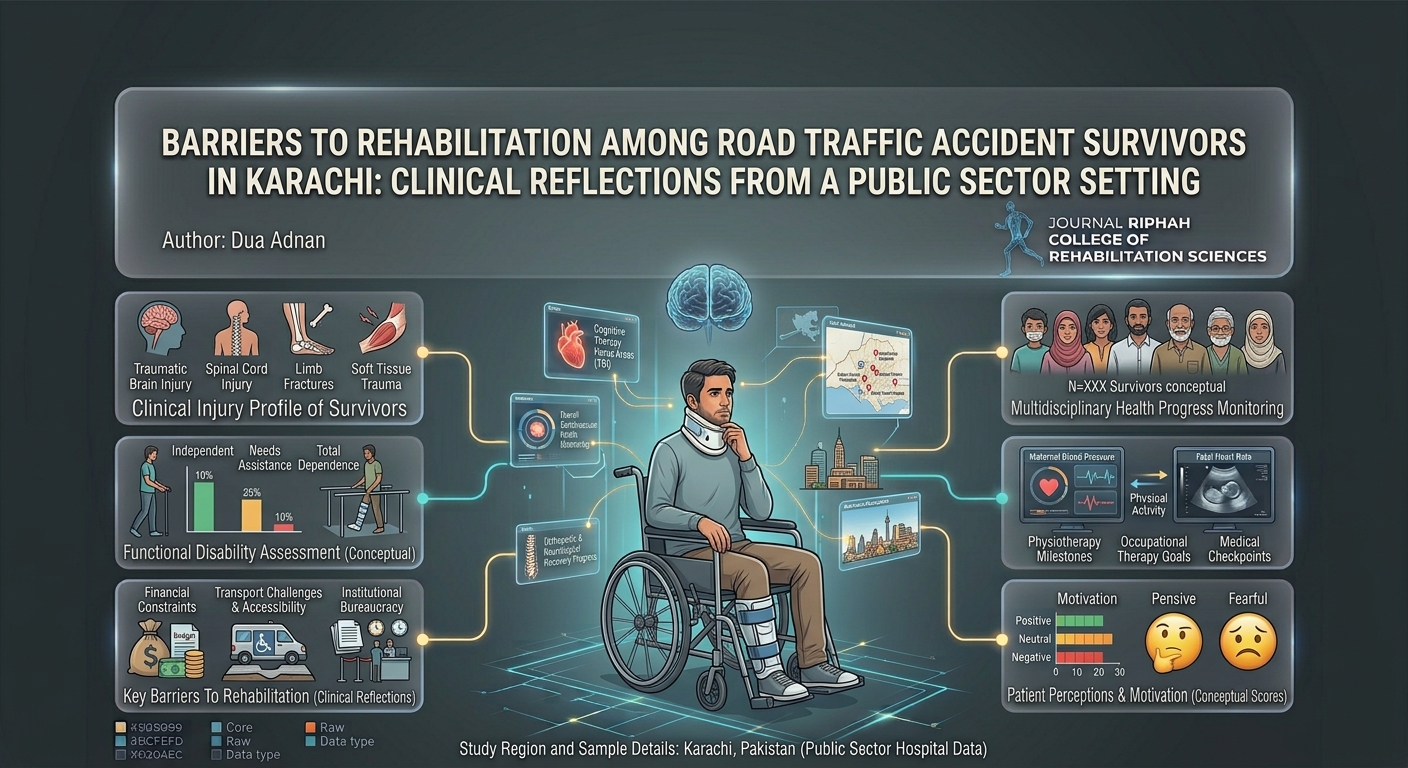
Road traffic accidents (RTAs) are a major cause of injury and disability in Karachi, with many survivors requiring prolonged rehabilitation. However, adherence to physiotherapy in public hospitals remains inconsistent. This commentary draws on recurring clinical observations from a tertiary care public hospital and integrates available local and international literature to highlight common barriers to rehabilitation among RTA survivors. Financial constraints, work-related pressures, transport difficulties, limited awareness regarding the importance of physiotherapy, pain during therapy, and overcrowded outpatient departments were frequently observed. Psychosocial factors, including emotional distress and reduced motivation, further contributed to early discontinuation of rehabilitation. These socioeconomic and structural challenges negatively affect functional recovery and increase the risk of long-term disability. Addressing these barriers through patient education, improved accessibility, community-based rehabilitation models, and strengthening public-sector rehabilitation services is essential to improve outcomes for RTA survivors in resource-limited settings.
Keywords: Barriers, Physiotherapy adherence, Public hospitals, Rehabilitation, Road traffic accidents
References
Ahmed S, Farooq U, Javed R. Barriers to rehabilitation adherence among patients in Pakistan. Pak J Rehabil. 2022;11(3):22–29.
Rahman MM. Barriers to render quality orthopedic/physiotherapy services. Pak J Phys Ther. 2024;12(2):45–52.
World Health Org Organisation rehabilitation 2030: A call for action. Geneva; 2019.
Jack K, McLean SM, Moffett JK, Gardiner E. Barriers to treatment adherence in physiotherapy outpatients. BMC Musculoskeletal disorder. 2010;11:238
Social Policy and Research Centre. Pakistan Disability Report 2025. Islamabad; 2025.
Downloads
Published
How to Cite
Issue
Section
License
Copyright (c) 2026 Open access article distributed under the terms of Creative Commons "Attribution-NonCommercial 4.0 International" license. https://creativecommons.org/licenses/by-nc/4.0/. Copyrights on any open access article published by Journal Riphah College of Rehabilitation Science (JRCRS) are retained by the author(s). The use, distribution or reproduction in other forums is permitted, provided the original author(s) and the copyright owner(s) are credited and that the original publication in this journal is cited, in accordance with accepted academic practice. No use, distribution or reproduction is permitted, which does not comply with these terms.

This work is licensed under a Creative Commons Attribution-NonCommercial 4.0 International License.