Attitudes And Beliefs of Physiotherapists Towards Chronic Low Back Pain in Rawalpindi and Islamabad: A Cross-Sectional Study
Abstract
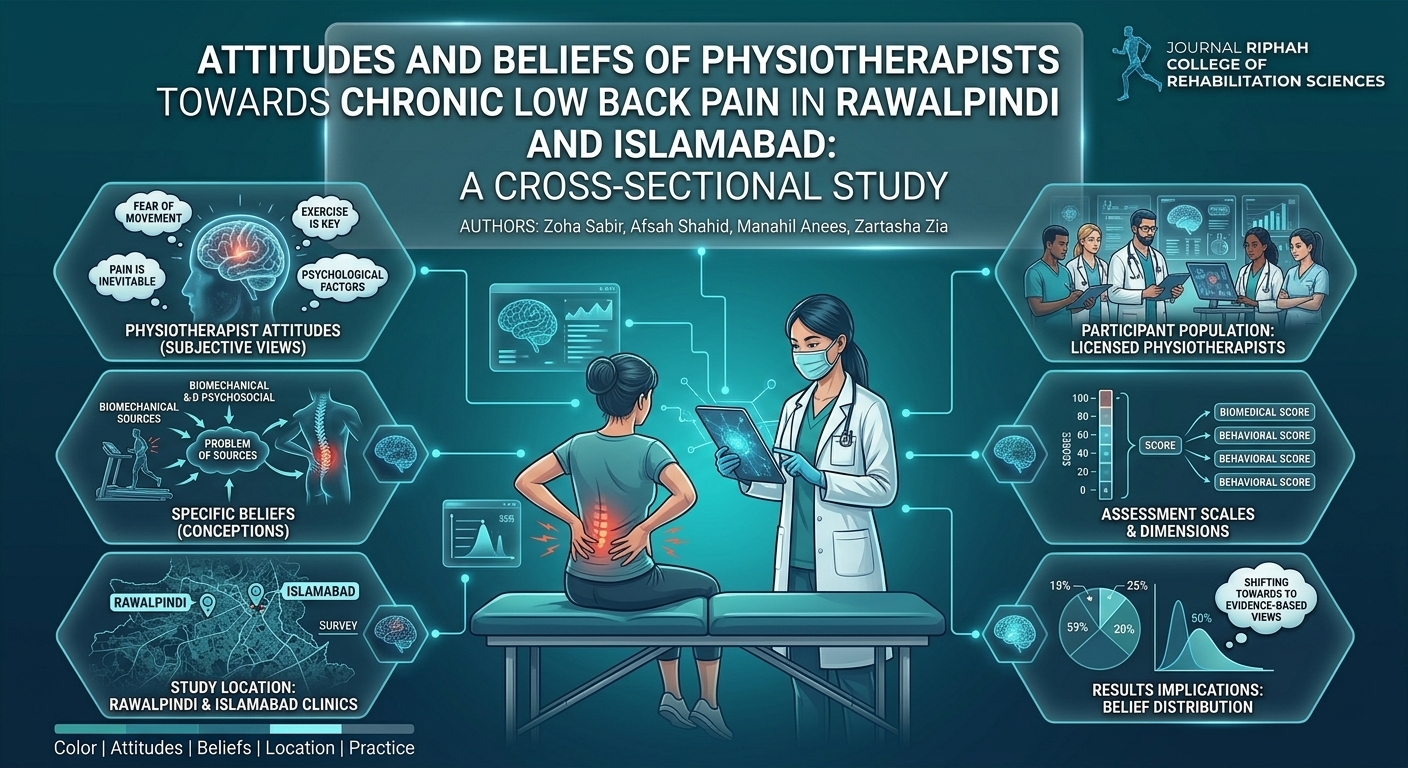
Background: Chronic low back pain affects 44.9% of the global population and is characterised as non-specific pain in the lower back lasting longer than three months. Patients often develop fear-avoidance behavior, which exacerbates their condition. Physiotherapists’ attitudes and beliefs can influence both the treatment approach and rehabilitation outcomes for patients. Two main approaches are used in managing chronic low back pain: the biomedical approach, which focuses on pain due to physical damage, and the biopsychosocial approach, which also considers psychological and social factors.
Objective: To assess whether physiotherapists in Rawalpindi and Islamabad lean more towards the biomedical or the biopsychosocial approach in managing chronic low back pain.
Methodology: A descriptive cross-sectional study was conducted from June 2023 to June 2024. A total of 191 physiotherapists were selected via non-probability convenience sampling. The PABS-PT was employed to measure physiotherapists’ attitudes and beliefs, featuring two subscales: biomedical and biopsychosocial, scored on a six-point Likert scale. Data was analysed using SPSS version 21. Descriptive statistics and graphical representations were used.
Results: Of the 191 participants, 57.6% were females and 42.4% males. 48.7% of physiotherapists attended specialised workshops for pain management. The mean biomedical score was 42.43±4.97, compared to 32.07±6.56 for the biopsychosocial subscale, indicating a stronger biomedical orientation.
Conclusion: The study concluded that most physiotherapists in Rawalpindi and Islamabad have a stronger inclination towards the biomedical approach in managing chronic low back pain, compared to the biopsychosocial approach.
Keywords: Attitudes, beliefs, chronic low back pain, physical therapist
References
Hoy D, Bain C, Williams G, March L, Brooks P, Blyth F, Woolf A, Vos T, Buchbinder R. Measuring the global burden of low back pain. Best Practice & Research Clinical Rheumatology, Volume 24, Issue 2, 2010, Pages 155-165.
Qaseem A, Wilt TJ, McLean RM, Forciea MA; Clinical Guidelines Committee of the American College of Physicians; Denberg TD, Barry MJ, Boyd C, Chow RD, Fitterman N, Harris RP, Humphrey LL, Vijan S. Noninvasive Treatments for Acute, Subacute, and Chronic Low Back Pain: A Clinical Practice Guideline From the American College of Physicians. Ann Intern Med. 2017 Apr 4;166(7):514-530. doi: 10.7326/M16-2367. Epub 2017 Feb 14
Andersson GB. Epidemiological features of chronic low-back pain. The lancet. 1999 Aug 14;354(9178):581-5.
Hadjistavropoulos T, Craig KD, editors. Pain: psychological perspectives. Psychology Press; 2004 Feb 4
Qaseem A, Wilt TJ, McLean RM, Forciea MA, Clinical Guidelines Committee of the American College of Physicians*. Noninvasive treatments for acute, subacute, and chronic low back pain: a clinical practice guideline from the American College of Physicians. Annals of internal medicine. 2017 Apr 4;166(7):514-30.
Gellhorn AC, Chan L, Martin B, Friedly J. Management patterns in acute low back: the role of physical therapy. Spine. 2012 Apr 4;37(9):775.
Childs JD, Fritz JM, Wu SS, Flynn TW, Wainner RS, Robertson EK, Kim FS, George SZ. Implications of early and guideline adherent physical therapy for low back pain on utilization and costs. BMC health services research. 2015 Jun;15(1):1-0.
Shipton EA. Physical therapy approaches in the treatment of low back pain. Pain and therapy. 2018 Dec;7:127-37.
DeRosa CP, Porterfield JA. A physical therapy model for the treatment of low back pain. Physical Therapy. 1992 Apr 1;72(4):261-9.
Foster NE, Anema JR, Cherkin D, Chou R, Cohen SP, Gross DP, Ferreira PH, Fritz JM, Koes BW, Peul W, Turner JA. Prevention and treatment of low back pain: evidence, challenges, and promising directions. The Lancet. 2018 Jun 9;391(10137):2368-83.
Daykin AR, Richardson B. Physiotherapists’ pain beliefs and their influence on the management of patients with chronic low back pain. Spine. 2004 Apr 1;29(7):783 95.
Nicholas, M. K., Linton, S. J., Watson, P. J., Main, C. J., & The Decade of the Flags Working Group. (2011). Early identification and management of psychological risk factors ("yellow flags") in patients with low back pain: a reappraisal. Physical Therapy, 91(5), 737-753.
Turk, D. C., Wilson, H. D., & Cahana, A. (2011). Treatment of chronic non-cancer pain. The Lancet, 377(9784), 2226-2235.
Petit A, Begue C, Richard I, Roquelaure Y. Factors influencing physiotherapists’ attitudes and beliefs toward chronic low back pain: Impact of a care network belonging. Physiotherapy Theory and Practice. 2019 May 4;35(5):437-43.
Alshehri MA, Alzahrani H, Alotaibi M, Alhowimel A, Khoja O. Physiotherapists’ pain attitudes and beliefs towards chronic low back pain and their association with treatment selection: a cross-sectional study. Bmj Open. 2020 Jun 1;10(6):e037159
Poitras S, Durand MJ, Côté AM, et al. Guidelines on low back pain disability: interprofessional comparison of use between general practitioners, occupational therapists, and physiotherapists. doi:10.1097/BRS.0b013e31824b6adf Spine. 2012;37(14):1252–1259.
Bishop A, Thomas E, Foster NE. Health care practitioners’ attitudes and beliefs about low back pain: a systematic search and critical review of available measurement tools. Pain. 2007 Nov 1;132(1-2):91-101.
Wu A, March L, Zheng X, Huang J, Wang X, Zhao J, Blyth FM, Smith E, Buchbinder R, Hoy D. Global low back pain prevalence and years lived with disability from 1990 to 2017: estimates from the Global Burden of Disease Study 2017. Ann Transl Med. 2020 Mar;8(6):299. doi: 10.21037/atm.2020.02.175.
Rufa A, Kolber MJ, Rodeghero J, Cleland J. The impact of physical therapist attitudes and beliefs on the outcomes of patients with low back pain. Musculoskeletal Science and Practice. 2021 Oct 1;55:102425.
Benny E, Evans C. Ontario musculoskeletal physiotherapists’ attitudes toward and beliefs about managing chronic low back pain. Physiotherapy Canada. 2020 Nov 1;72(4):355-63.
Synnott A, O’Keeffe M, Bunzli S, Dankaerts W, O'Sullivan P, Robinson K, O'Sullivan K. Physiotherapists report improved understanding of and attitude toward the cognitive, psychological and social dimensions of chronic low back pain after cognitive functional therapy training: a qualitative study. Journal of physiotherapy. 2016 Oct 1;62(4):215-21.
Alhowimel A, Alodaibi F, Alotaibi M, Alamam D, Fritz J. Comparison of attitudes and beliefs of physical therapists and primary care physicians regarding low back pain management: a cross-sectional study. Journal of Back and Musculoskeletal Rehabilitation. 2022 Jan 1;35(4):803-9.
Downloads
Published
How to Cite
Issue
Section
License
Copyright (c) 2026 Open access article distributed under the terms of Creative Commons "Attribution-NonCommercial 4.0 International" license. https://creativecommons.org/licenses/by-nc/4.0/. Copyrights on any open access article published by Journal Riphah College of Rehabilitation Science (JRCRS) are retained by the author(s). The use, distribution or reproduction in other forums is permitted, provided the original author(s) and the copyright owner(s) are credited and that the original publication in this journal is cited, in accordance with accepted academic practice. No use, distribution or reproduction is permitted, which does not comply with these terms.

This work is licensed under a Creative Commons Attribution-NonCommercial 4.0 International License.