Knowledge, Attitude, and Practice of Antenatal Exercises and Physical Activity Levels Among Pregnant Women in Islamabad and Rawalpindi: A Cross-Sectional Study
Abstract
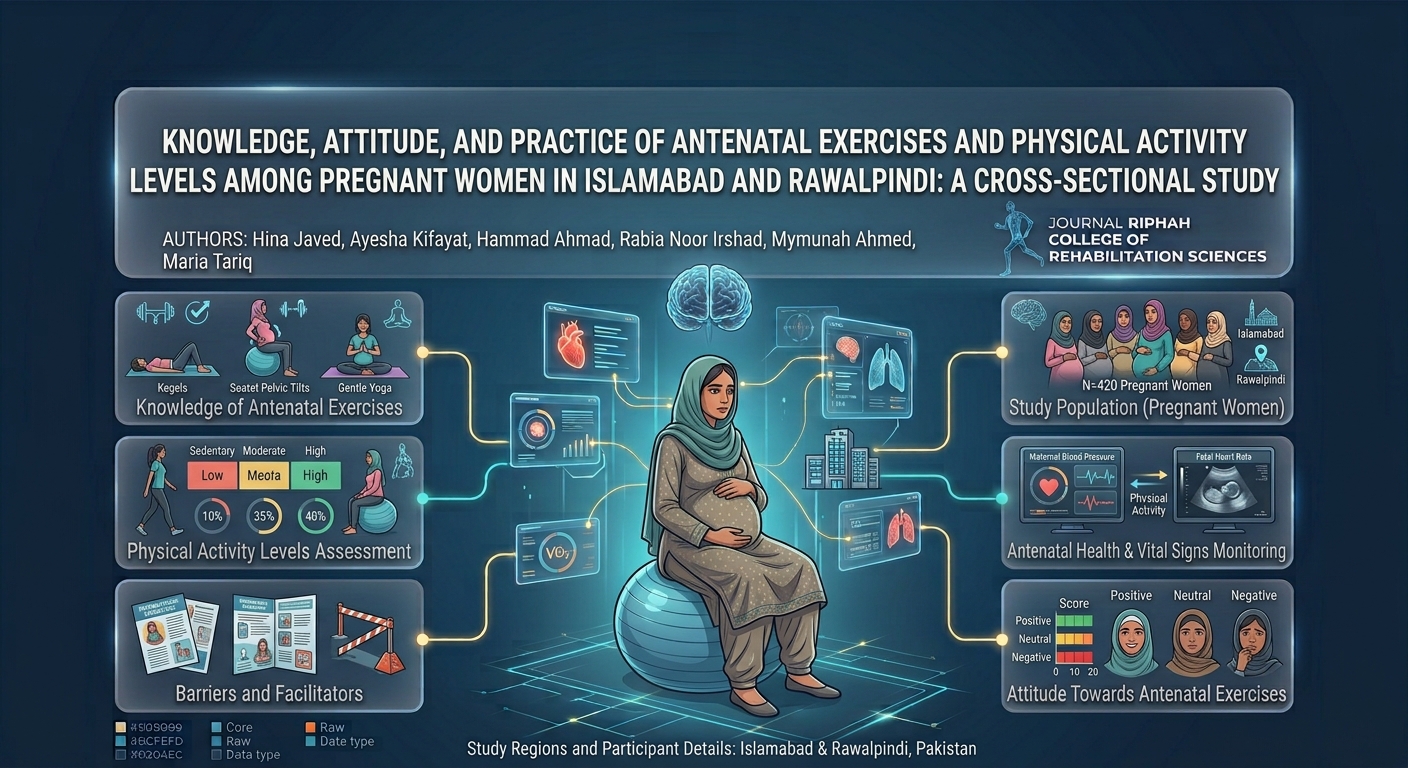
Background: A healthy and active pregnancy period benefits both the mother and the fetus indicating the value of antenatal exercise knowledge and which was not as well discussed. Pregnant women who pay little attention to antenatal exercise and physical activity may gain too much weight and experience additional problems during and even after pregnancy.
Objective: To evaluate the knowledge, attitudes, and practices related to antenatal exercises and to identify the levels of physical activity among the pregnant women.
Methodology: The Polish Version of the Pregnancy Physical Activity Questionnaire (PPAQ-PI) and the knowledge Attitude and Practice Questionnaire (KAP) were used in a descriptive cross-sectional study with a sample size of 137 pregnant women to gauge their level of physical activity and knowledge. We determine the relationship between age, miscarriage history, and knowledge score using a chi-square. Physical activity and KAP patterns were interpreted as Frequency tables. SPSS version 25 was used for data entry and analysis.
Results: Current study show that 55% of participants have adequate knowledge of antenatal exercises, while 44% lack sufficient knowledge. 47% of women engage in physical activity, whereas 51% do not meet the recommended levels.
Conclusion: This study explored pregnant women (primigravida, multigravida) knowledge and practices regarding antenatal exercises and physical activity. Factors like age, family size, and daily habits were found to impact their understanding and adoption of healthy physical activity during pregnancy.
Keywords: Antenatal, Exercise, Pregnancy, Physical Activity
References
Santini C, Imakawa TD, Moisés EC. Physical activity during pregnancy: recommendations and assessment tools. Revista Brasileira de Ginecologia e Obstetrícia. 2017;39:424-32.
Nadeem S, Khatoon A, Rasheed S, Munim TF. The physical activity patterns among pregnant women at a tertiary care hospital in, Pakistan. Pakistan Journal of Medical Sciences. 2022 Mar;38(4Part-II):904
Janakiraman B, Gebreyesus T, Yihunie M, Genet MG. Knowledge, attitude, and practice of antenatal exercises among pregnant women in Ethiopia: A cross-sectional study. PloS one. 2021 Feb 19;16(2):e0247533.
Kumar VK. Knowledge, perception, and attitude of pregnant women towards the role of physical therapy in antenatal care-a cross sectional study. Online Journal of Health and Allied Sciences. 2016 Jan 30;14(4)
Wadhwa Y, Alghadir AH, Iqbal ZA. Effect of antenatal exercises, including yoga, on the course of labor, delivery and pregnancy: A retrospective study. International journal of environmental research and public health. 2020 Aug;17(15):5274
Alghamdi W. Socio-demographic predictors of knowledge, attitude and practice of antenatal exercise among pregnant women. Med Sci. 2023 Feb 5;27(132):1-9
DiPietro L, Evenson KR, Bloodgood B, Sprow K, Troiano RP, Piercy KL, Vaux-Bjerke A, Powell KE. Benefits of physical activity during pregnancy and postpartum: an umbrella review. Medicine and science in sports and exercise. 2019 Jun;51(6):1292
Rogers JM. Smoking and pregnancy: Epigenetics and developmental origins of the metabolic syndrome. Birth defects research. 2019 Oct 15;111(17):1259-69.
Badon SE, Littman AJ, Chan KC, Tadesse MG, Stapleton PL, Bammler TK, Sorensen TK, Williams MA, Enquobahrie DA. Physical activity and epigenetic biomarkers in maternal blood during pregnancy. Epigenomics. 2018 Nov;10(11):1383-95
Mottola MF, Davenport MH, Ruchat SM, Davies GA, Poitras VJ, Gray CE, Garcia AJ, Barrowman N, Adamo KB, Duggan M, Barakat R. 2019 Canadian guideline for physical activity throughout pregnancy. British journal of sports medicine. 2018 Nov 1;52(21):1339-46
Alghamdi W. Socio-demographic predictors of knowledge, attitude and practice of antenatal exercise among pregnant women. Med Sci. 2023 Feb 5;27(132):1-9.
Alnaeem L, Alkulaib SS, Alatiyyah ZJ, Alrashed NR, Alnaim AA, Alnaim SS. Pregnant Women's Knowledge, Attitudes, and Associated Factors Toward Physical Exercise During Pregnancy in Al-Ahsa City, KSA. Cureus. 2024 Mar;16(3).
Negash BT, Alelgn Y. Knowledge, attitude and practice of physical exercises among pregnant women attending prenatal care clinics of public health institutions in Hawassa city, Sidama, Ethiopia, in 2021: descriptive cross-sectional study. BMC women's health. 2023 Nov 27;23(1):630..
Temtanakitpaisan T, Bunyavejchevin S, Buppasiri P, Chongsomchai C. Knowledge, attitude, and practices (KAP) survey towards pelvic floor muscle training (PFMT) among pregnant women. International journal of women's health. 2020 Apr 17:295-9Kołomańska-Bogucka D, Mazur-Bialy AI. Physical activity and the occurrence of postnatal depression a systematic review. Medicina. 2019 Sep 2;55(9):560
Nakamura A, van der Waerden J, Melchior M, Bolze C, El-Khoury F, Pryor L. Physical activity during pregnancy and postpartum depression: Systematic review and meta-analysis. Journal of Affective Disorders. 2019 Mar 1;246:29-41
Marín‐Jiménez N, Acosta‐Manzano P, Borges‐Cosic M, Baena‐García L, Coll‐Risco I, Romero‐Gallardo L, Aparicio VA. Association of self‐reported physical fitness with pain during pregnancy: The GESTAFIT Project. Scandinavian journal of medicine & science in sports. 2019 Jul;29(7):1022-30
Mohamed AS, Khedr NF, Elsherbiny EA. Effect of practicing sitting pelvic tilt exercise on the intensity of pregnancy-related lumbopelvic pain. International Journal of Nursing. 2020 Dec;7(2):121-8.
Wojtyla A, Kapka-Skrzypczak L, Bilinski P, Paprzycki P. Physical activity among women at reproductive age and during pregnancy (Youth Behavioural Polish Survey–YBPS and Pregnancy-related Assessment Monitoring Survay–PrAMS)–epidemiological population studies in Poland during the period 2010-2011. Annals of Agricultural and Environmental Medicine. 2011;18(2).
Nikolovska L, Stojanova N, Spasov M. Role of Kegel exercises during pregnancy and after childbirth. KNOWLEDGE-International Journal. 2021 Oct 7;48(3):405-9
Ramachandra P, Kumar P, Kamath A, Maiya AG. Effect of intrinsic and extrinsic foot muscle strengthening exercises on foot parameters and foot dysfunctions in pregnant women: a randomized controlled trial. International Journal of Therapy And Rehabilitation. 2019 Feb 2;26(2):1-1
Harrison CL, Thompson RG, Teede HJ, Lombard CB. Measuring physical activity during pregnancy. International Journal of Behavioral Nutrition and Physical Activity. 2011Dec;8:1-8
Downloads
Published
How to Cite
Issue
Section
License
Copyright (c) 2026 Open access article distributed under the terms of Creative Commons "Attribution-NonCommercial 4.0 International" license. https://creativecommons.org/licenses/by-nc/4.0/. Copyrights on any open access article published by Journal Riphah College of Rehabilitation Science (JRCRS) are retained by the author(s). The use, distribution or reproduction in other forums is permitted, provided the original author(s) and the copyright owner(s) are credited and that the original publication in this journal is cited, in accordance with accepted academic practice. No use, distribution or reproduction is permitted, which does not comply with these terms.

This work is licensed under a Creative Commons Attribution-NonCommercial 4.0 International License.