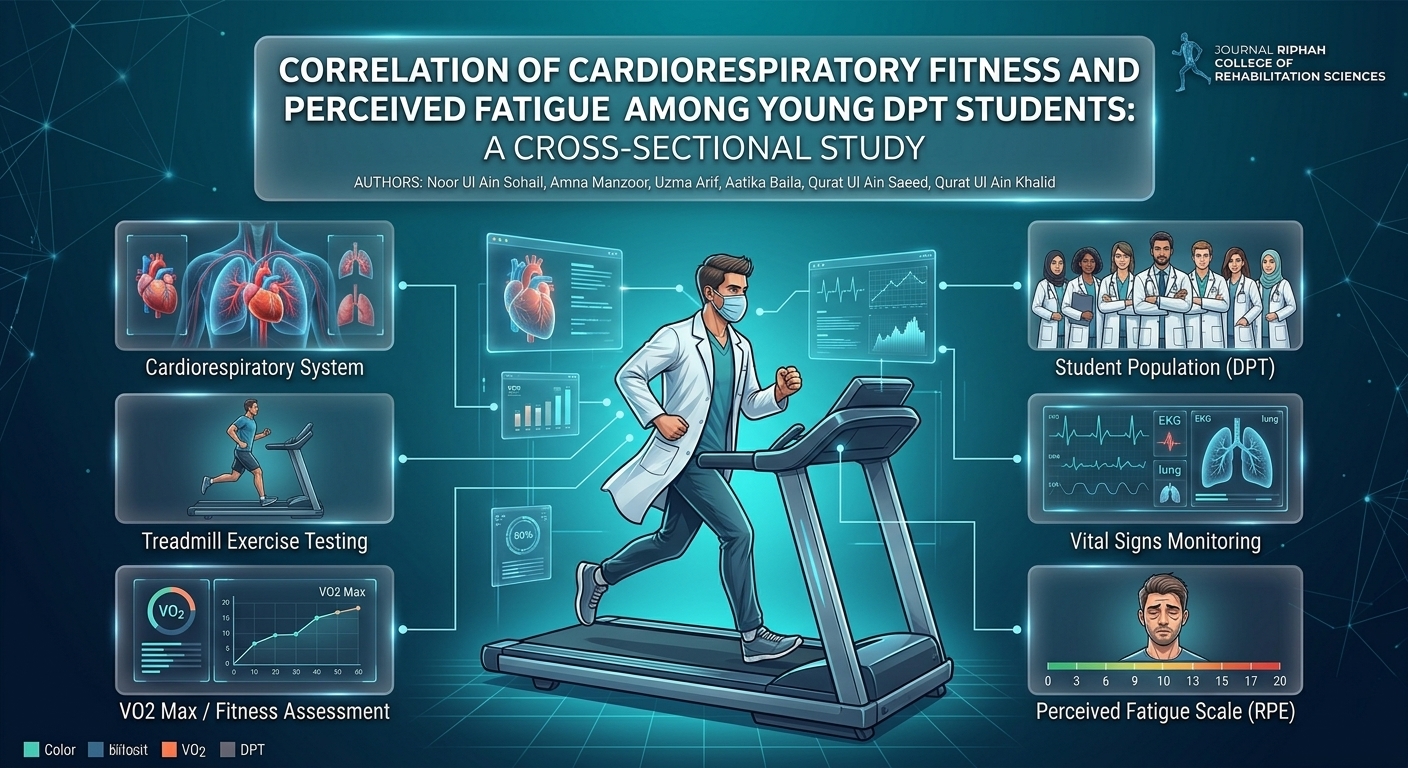
Correlation of Cardiorespiratory Fitness and Perceived Fatigue Among Young DPT Students: A Cross-Sectional Study
Abstract
Background: Cardiorespiratory fitness is a measure of how well oxygen is transported to the body during exertion and perceived fitness is the measure of perceived exhaustion and tiredness.
Objective: The aim of this study is to determine the correlation between cardiorespiratory fitness and perceived fatigue among young DPT adults.
Methodology: The methodology was approved by the Ethical Review Committee of Foundation University Islamabad. The study design was cross-sectional correlation analytical. The data was collected from undergraduate students of Foundation University Institute of Rehabilitation Sciences, Islamabad. The sampling technique was non-probability consecutive sampling. The sample size was 218. Data of 176 participants was collected due to limitation of time. Informed consent was taken. Participants were selected through inclusion and exclusion criteria and screened out using Physical Activity Readiness-Questionnaire. They were asked to fill the Situational Fatigue Scale and then perform the Single Stage Sub Maximal Treadmill Walking Test/Ebbeling Treadmill Test. During the test, participant's level of exertion and fatigue was measured using Borg Rating of Perceived Exertion. Then VO2 max and Situational Fatigue Score were calculated.
Results: There was weak positive correlation between cardiorespiratory fitness and perceived fatigue which was statistically insignificant (p value 0.545 and spearman’s rho 0.046).
Conclusion: Cardiorespiratory fitness varies among young DPT students and is not related to their perceived fatigue.
Keywords: Cardiorespiratory fitness, Perceived fatigue, Physical exertion
References
Myers J, Kokkinos P, Arena R, LaMonte MJ. The impact of moving more, physical activity, and cardiorespiratory fitness: why we should strive to measure and improve fitness. Progress in cardiovascular diseases. 2021;64:77-82.
Bonikowske AR, Taylor JL, Larson KF, Hardwick J, Ozemek C, Harber MP, et al. Evaluating current assessment techniques of cardiorespiratory fitness. Expert Review of Cardiovascular Therapy. 2024;22(6):231-41.
Harber MP, Myers J, Bonikowske AR, Muntaner-Mas A, Molina-Garcia P, Arena R, et al. Assessing cardiorespiratory fitness in clinical and community settings: Lessons and advancements in the 100th year anniversary of VO2max. Progress in Cardiovascular Diseases. 2024.
Batalik L, Konecny V, Dosbaba F, Vlazna D, Brat K. Cardiac rehabilitation based on the walking test and telerehabilitation improved cardiorespiratory fitness in people diagnosed with coronary heart disease during the COVID-19 pandemic. International Journal of Environmental Research and Public Health. 2021;18(5):2241.
Lang JJ, Prince SA, Merucci K, Cadenas-Sanchez C, Chaput J-P, Fraser BJ, et al. Cardiorespiratory fitness is a strong and consistent predictor of morbidity and mortality among adults: an overview of meta-analyses representing over 20.9 million observations from 199 unique cohort studies. British journal of sports medicine. 2024;58(10):556-66.
Shetty NS, Parcha V, Patel N, Yadav I, Basetty C, Li C, et al. AHA Life's essential 8 and ideal cardiovascular health among young adults. American journal of preventive cardiology. 2023;13:100452.
Murawska-Ciałowicz E, de Assis GG, Clemente FM, Feito Y, Stastny P, Zuwała-Jagiełło J, et al. Effect of four different forms of high intensity training on BDNF response to Wingate and Graded Exercise Test. Scientific reports. 2021;11(1):8599.
Turner JE. Maximal exercise stress test. Encyclopedia of Behavioral Medicine. 2020:1346-7.
Parizher G, Emery MS. Exercise stress testing in athletes. Clinics in sports medicine. 2022;41(3):441-54.
Reed JL, Cotie LM, Cole CA, Harris J, Moran B, Scott K, et al. Submaximal exercise testing in cardiovascular rehabilitation settings (BEST Study). Frontiers in physiology. 2020;10:1517.
Morrison M, Martin DT, Talpey S, Scanlan AT, Delaney J, Halson SL, et al. A systematic review on fitness testing in adult male basketball players: tests adopted, characteristics reported and recommendations for practice. Sports Medicine. 2022;52(7):1491-532.
Kaminsky LA, Arena R, Myers J, Peterman JE, Bonikowske AR, Harber MP, et al., editors. Updated reference standards for cardiorespiratory fitness measured with cardiopulmonary exercise testing: data from the Fitness Registry and the Importance of Exercise National Database (FRIEND). Mayo clinic proceedings; 2022: Elsevier.
Enoka RM, Duchateau J. Translating fatigue to human performance. Medicine and science in sports and exercise. 2016;48(11):2228.
Mosleh SM, Shudifat RM, Dalky HF, Almalik MM, Alnajar MK. Mental health, learning behaviour and perceived fatigue among university students during the COVID-19 outbreak: a cross-sectional multicentric study in the UAE. BMC psychology. 2022;10(1):47.
Schellekens MP, Wolvers MD, Schroevers MJ, Bootsma TI, Cramer AO, van der Lee ML. Exploring the interconnectedness of fatigue, depression, anxiety and potential risk and protective factors in cancer patients: a network approach. Journal of behavioral medicine. 2020;43:553-63.
Behrens M, Gube M, Chaabene H, Prieske O, Zenon A, Broscheid K-C, et al. Fatigue and human performance: an updated framework. Sports medicine. 2023;53(1):7-31.
Yang C-M, Wu C-H. The situational fatigue scale: a different approach to measuring fatigue. Quality of Life Research. 2005;14(5):1357-62.
Roberts DE, Futrell EE, Toole E. Submaximal walking tests: a review of clinical use. Journal of Clinical Exercise Physiology. 2022;11(2):62-74.
Kilpatrick M, Newsome AN, Foster C, Robertson R, Green M. Scientific rationale for RPE use in fitness assessment and exercise participation. ACSM's Health & Fitness Journal. 2020;24(4):24-30.
Lea JW, O’Driscoll JM, Coleman DA, Wiles JD. Validity and reliability of RPE as a measure of intensity during isometric wall squat exercise. Journal of Clinical and Translational Research. 2021;7(2):248.
Van Rijn R, Van Lange PA, Krabbendam L, Braams BR. Construction and validation of the prosocial adolescent risk-taking questionnaire (PAR-Q). Scientific Reports. 2025;15(1):21252.
Losa-Iglesias ME, Becerro-de-Bengoa-Vallejo R, Becerro-de-Bengoa-Losa KR. Reliability and concurrent validity of a peripheral pulse oximeter and health–app system for the quantification of heart rate in healthy adults. Health informatics journal. 2016;22(2):151-9.
Bushman BA. Estimating maximal heart rate. ACSM's Health & Fitness Journal. 2023;27(6):5-8.
Costill DL, Kenney WL, Wilmore J. Physiology of sport and exercise: Human kinetics; 2008.
Scafoglieri A, Clarys JP, Bauer JM, Verlaan S, Van Malderen L, Vantieghem S, et al. Predicting appendicular lean and fat mass with bioelectrical impedance analysis in older adults with physical function decline–The PROVIDE study. Clinical Nutrition. 2017;36(3):869-75.
Valet M, Lejeune T, Glibert Y, Hakizimana JC, Van Pesch V, El Sankari S, et al. Fatigue and physical fitness of mildly disabled persons with multiple sclerosis: a cross-sectional study. International Journal of Rehabilitation Research. 2017;40(3):268-74.
Peterson JA, Staud R, Thomas PA, Goodin BR, Fillingim RB, Cruz-Almeida Y. Self-reported pain and fatigue are associated with physical and cognitive function in middle to older-aged adults. Geriatric Nursing. 2023;50:7-14.
Teh WL, Abdin E, PV A, Siva Kumar FD, Roystonn K, Wang P, et al. Measuring social desirability bias in a multi-ethnic cohort sample: its relationship with self-reported physical activity, dietary habits, and factor structure. BMC Public Health. 2023;23(1):415.
Adão Martins NR, Annaheim S, Spengler CM, Rossi RM. Fatigue monitoring through wearables: a state-of-the-art review. Frontiers in physiology. 2021;12:790292.
Tornero-Aguilera JF, Jimenez-Morcillo J, Rubio-Zarapuz A, Clemente-Suárez VJ. Central and peripheral fatigue in physical exercise explained: A narrative review. International journal of environmental research and public health. 2022;19(7):3909.
Gu M, Xiao L, Wang J, Cai Q, Liu Y, Xu P, et al. Obesity and poststroke fatigue: a 2-year longitudinal study. Neurology and Therapy. 2021;10(2):955-69.
Kaminsky LA, Arena R, Myers J, editors. Reference standards for cardiorespiratory fitness measured with cardiopulmonary exercise testing: data from the Fitness Registry and the Importance of Exercise National Database. Mayo Clinic Proceedings; 2015: Elsevier.
Downloads
Published
How to Cite
Issue
Section
License
Copyright (c) 2026 Open access article distributed under the terms of Creative Commons "Attribution-NonCommercial 4.0 International" license. https://creativecommons.org/licenses/by-nc/4.0/. Copyrights on any open access article published by Journal Riphah College of Rehabilitation Science (JRCRS) are retained by the author(s). The use, distribution or reproduction in other forums is permitted, provided the original author(s) and the copyright owner(s) are credited and that the original publication in this journal is cited, in accordance with accepted academic practice. No use, distribution or reproduction is permitted, which does not comply with these terms.

This work is licensed under a Creative Commons Attribution-NonCommercial 4.0 International License.