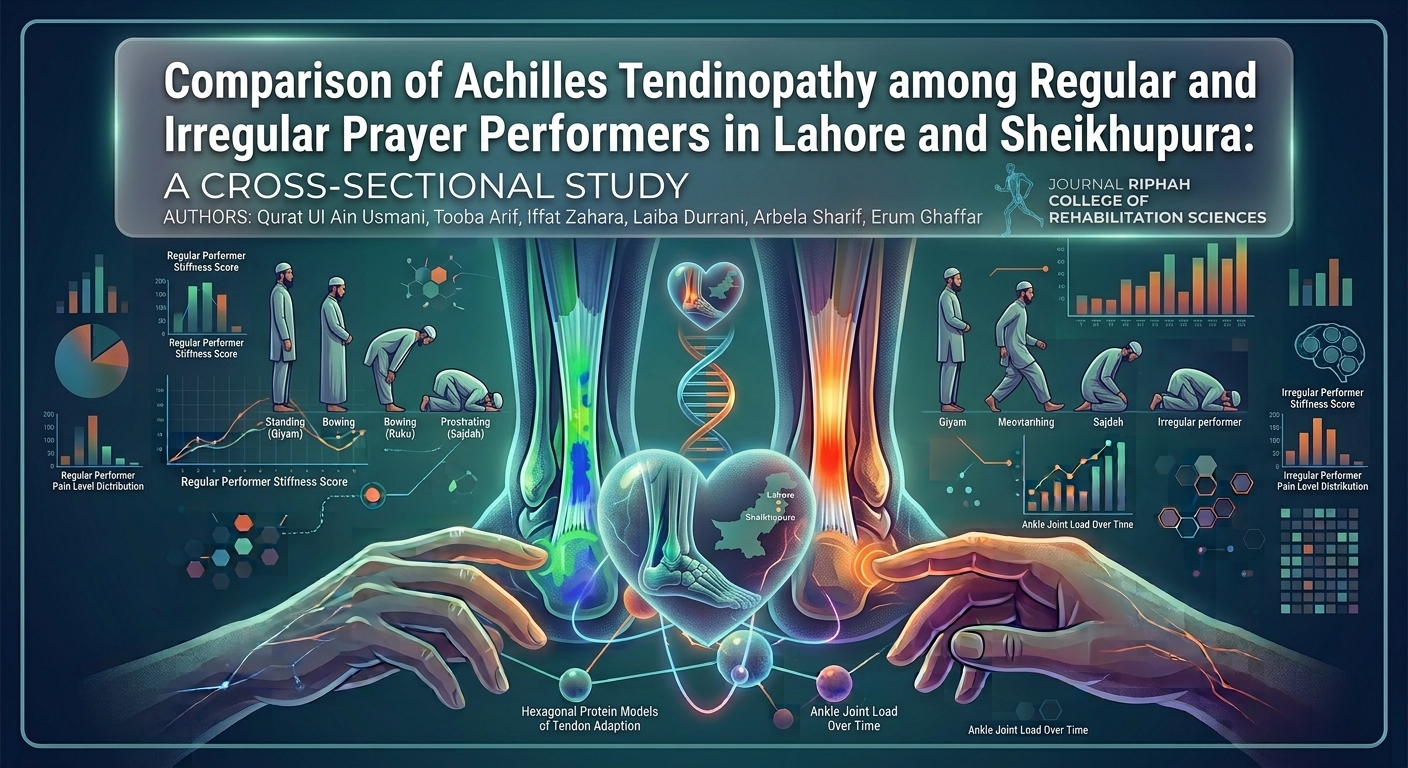
Comparison of Achilles Tendinopathy among Regular and Irregular Prayer Performers in Lahore and Sheikhupura: A Cross-Sectional Study
Abstract
Background: Achilles tendinopathy (AT) is a common overuse condition characterized by pain and functional limitation during weight-bearing activities. Repetitive movements involved in daily prayer may influence tendon health.
Objective: To determine the comparison of Achilles Tendinopathy in Regular and Irregular prayer offers of Lahore and Sheikhupura.
Methodology: The cross-sectional survey employed non-probability convenient sampling, enrolling 384 male participants age between 25-55 years with Achilles tendinopathy. Tendinopathy was assessed using the VISA-A questionnaire. The sample population to 384 people who were divided into two groups which were regular and irregular prayer offers from different mosques of Lahore and Sheikhupura. The specified inclusion criteria encompass the Achilles tendon which may experience pain or discomfort when individuals engage in weight-bearing plantar flexion actions, such as running or leaping. Participants with a history of total Achilles tendon rupture, other therapies, exercise limitations, or pain from insertional tendinopathy or bursitis were excluded. Data analysis is done by using the IBM SPSS Statistics 25.
Results: Among 384 participants, 192 were regular and 192 were irregular prayer performers. Regular performers demonstrated higher VISA-A scores, indicating better tendon function. Asymptomatic AT was reported in 79.7% of regular performers compared to 40.1% of irregular performers. Symptomatic AT was more prevalent among irregular performers (59.9%) compared to regular performers (20.3%). A statistically significant association was found between prayer frequency and AT status (p = 0.039).
Conclusion: A significant association exists between prayer frequency and Achilles tendinopathy status. Regular prayer performers showed better tendon-related outcomes compared to irregular performers. However, causal relationships cannot be established due to the cross-sectional design.
Keywords: Achilles Tendinopathy, Musculoskeletal Health, Prayer, Physical Activity, VISA-A
References
Chukwuemeka U, Anyoku C, Onwuakagba I, Akobundu U. Prevalence and Risk Factors of Achilles Tendinopathy among University Soccer Players. Int J Sports Exerc Med. 2022;8:223.
Sharif A, Mehmood S, Mahmood B, Siddiqa A, Hassan MAA, Afzal M. Comparison of Hamstrings Flexibility among Regular and Irregular Muslim Prayer Offerers: Hamstring Flexibility in Muslim Prayer Offerers. The Healer Journal of Physiotherapy and Rehabilitation Sciences. 2023;3(1):329-33.
Yasin A, Mubeen I. Severity of achilles tendinopathy in athletes of The University of Lahore, Lahore. Journal of Rehabilitation and Clinical Research (JRCR). 2023;1(1):6-9.
Kousar R, Sanaullah M, Ikram M, Aleem A, Memon AG, ur Rehman SS. Effects of ultrasound therapy versus transverse friction massage along with eccentric exercise program on chronic achilles tendinopathy. The Rehabilitation Journal. 2022;6(02):333-7.
Khalid F, Ahmed N, Shafiq M. To determine the frequency of achilles tendon involvement in psoriasis by ultrasound. Pakistan Journal of Radiology. 2017;27(1).
Arshad Z, Ammar A, Arshad M, Mirza TM, Arshad T, Arshad D, et al. Association between Achilles and Plantar Calcaneal Spur in Pakistani Population Presenting with Ankle/Heel Pain.
Malliaras P. Physiotherapy management of Achilles tendinopathy. Journal of Physiotherapy. 2022.
Farbu EH, Höper AC, Brenn T, Skandfer M. Is working in a cold environment associated with musculoskeletal complaints 7–8 years later? A longitudinal analysis from the Tromsø Study. International archives of occupational and environmental health. 2021;94:611-9.
Schwabe K, de Villiers R, Collins M, Schwellnus MP. Achilles tendon blood flow changes in response to acute exercise. International SportMed Journal. 2007;8(3).
Yang C-C, Yu X, Guo Z-H, Fu Y-W. The biomechanical study of rupture of Achilles Tendon and repair by different suture techniques. Pakistan Journal of Medical Sciences. 2018;34(3):638.
Canfer R, Chaudry S, Miller S. Thermographic assessment of the immediate and short term-effects of blood flow restriction exercise on Achilles tendon skin temperature. Physical Therapy in Sport. 2021;49:171-7.
Slouma M, Dhia SB, Bellagha C, Metoui L, Dhahri R, Gharsallah I, et al. AB1336 Effects Of Muslim Prayer On Lower Limb Enthesis Ultrasound. BMJ Publishing Group Ltd; 2022.
Slagers AJ, van Veen E, Zwerver J, Geertzen JH, Reininga IH, Van den Akker-Scheek I. Psychological factors during rehabilitation of patients with Achilles or patellar tendinopathy: a cross-sectional study. Physical Therapy in Sport. 2021;50:145-52.
Mallows A, Head J, Goom T, Malliaras P, O'Neill S, Smith B. Patient perspectives on participation in exercise-based rehabilitation for Achilles tendinopathy: A qualitative study. Musculoskeletal Science and Practice. 2021;56:102450.
Silva RS, Smitheman HP, Smith AK, Silbernagel KG. Are static foot posture and ankle dorsiflexion range of motion associated with Achilles tendinopathy? A cross-sectional study. Brazilian Journal of Physical Therapy. 2022;26(6):100466.
İmamoğlu O. Benefits of prayer as a physical activity. International Journal of Sport Culture and Science. 2016;4(Special Issue 1):306-18.
Qualtrics. 2023.
Lieberthal K, Paterson KL, Cook J, Kiss Z, Girdwood M, Bradshaw EJ. Prevalence and factors associated with asymptomatic Achilles tendon pathology in male distance runners. Physical Therapy in Sport. 2019;39:64-8.
Sigurdsson HB, Maguire MC, Balascio P, Silbernagel KG. Effects of kinesiophobia and pain on performance and willingness to perform jumping tests in Achilles tendinopathy: a cross-sectional study. Physical Therapy in Sport. 2021;50:139-44.
Jalal AH. Morphological, neuromuscular and cardiovascular disease risk profiles among asymptomatic sedentary males performing Salaah (Islamic prayer): University of Johannesburg (South Africa); 2021.
Smith MD, Vicenzino B, Brown WJ, Gilson ND, Gane EM, Johnston V. Symptom characteristics in office workers using standing workstations: A cross-sectional study. Brazilian Journal of Physical Therapy. 2022;26(2):100393.
Downloads
Published
How to Cite
Issue
Section
License
Copyright (c) 2026 Open access article distributed under the terms of Creative Commons "Attribution-NonCommercial 4.0 International" license. https://creativecommons.org/licenses/by-nc/4.0/. Copyrights on any open access article published by Journal Riphah College of Rehabilitation Science (JRCRS) are retained by the author(s). The use, distribution or reproduction in other forums is permitted, provided the original author(s) and the copyright owner(s) are credited and that the original publication in this journal is cited, in accordance with accepted academic practice. No use, distribution or reproduction is permitted, which does not comply with these terms.

This work is licensed under a Creative Commons Attribution-NonCommercial 4.0 International License.