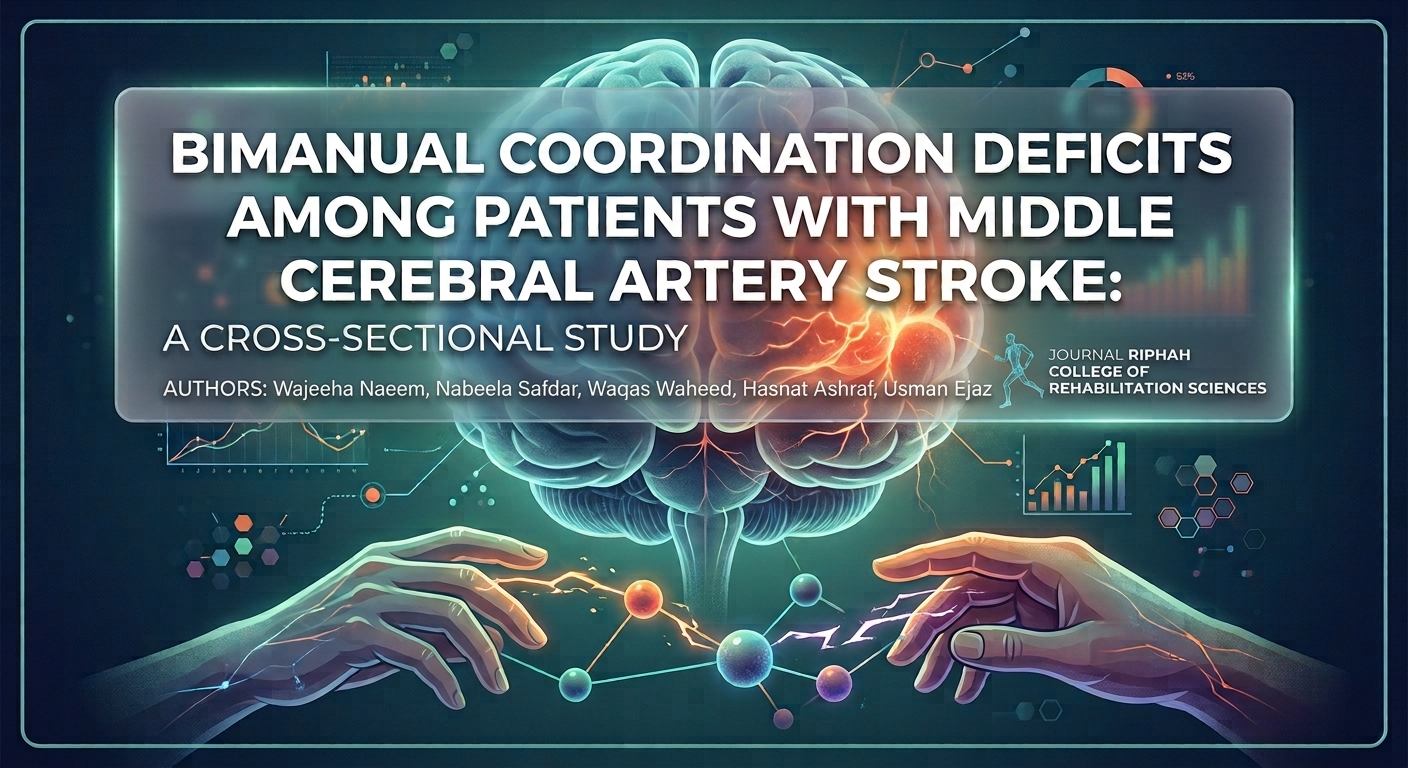
Bimanual Coordination Deficits Among Patients with Middle Cerebral Artery Stroke: A Cross-Sectional Study
Abstract
Background: Middle cerebral artery stroke is the most common type of ischemic stroke. MCA stroke results in the motor impairments of the affected upper limb, which can lead to the disruption of the bimanual hand coordination and increase limitations in activities of daily living.
Objective: To determine bimanual coordination deficits among patients with Middle cerebral artery stroke.
Methodology: 70 patients were selected according to inclusion criteria (Middle cerebral artery stroke, 4 months post stroke, age ranging from 30 to 60 years. Exclusion criteria included the stroke of any other artery, fractures, or other pathologies affecting the upper limb function, pain, and discomfort while doing the tasks. Data was analyzed using the Statistical Package for Social Sciences (SPSS) version 26. Bimanual coordination was determined by using the ABILHAND Questionnaire. The study was done using non-probability convenience sampling. The sample size is limited to 70 participants because of the strict eligibility criteria (chronic MCA stroke, Brannstrom ≥4). While it limits external generalizability, enhances the internal validity, limits the homogeneity and allows the focused profiling of the persistent bimanual deficits. The findings will be preliminary, however clinically indicative within the context of similar tertiary care.
Results: The study assessed the bimanual coordination in 70 patients with the middle cerebral artery stroke via using the ABILHAND questionnaire. The findings revealed the mean score of 18.9 ± 10.7, markedly below the standard values, indicating the significant deficits. Tasks which required fine bimanual dexterity were perceived as most difficult, while the simpler, unimanual-sequence tasks were rated as easier. The results highlighted the substantial limitations in the self-perceived daily hand activities, underscoring need for the targeted rehabilitation strategies.
Conclusion: Bimanual coordination deficits were present in patients with Middle cerebral artery stroke, as a mean of the total score of the ABILHAND Questionnaire was lower.
Keywords: ABILHAND, Bimanual coordination, Middle Cerebral Artery, Stroke
References
Nogles TE, Galuska MA. Middle cerebral artery stroke. StatPearls [Internet]: StatPearls Publishing; 2023.
O'Sullivan SB, Schmitz TJ, Fulk G. Physical rehabilitation: FA Davis; 2019.
Farooq A, Venketasubramanian N, Wasay M. Stroke care in Pakistan. Cerebrovascular Diseases Extra. 2021;11(3):118-21.
Johnson T, Ridgeway G, Luchmee D, Jacob J, Kantak S. Bimanual coordination during reach-to-grasp actions is sensitive to task goal with distinctions between left-and right-hemispheric stroke. Experimental brain research. 2022;240(9):2359-73.
Schaffer JE, Maenza C, Good DC, Przybyla A, Sainburg RL. Left hemisphere damage produces deficits in predictive control of bilateral coordination. Experimental Brain Research. 2020;238:2733-44.
Kim RK, Kang N. Bimanual coordination functions between paretic and nonparetic arms: a systematic review and meta-analysis. Journal of Stroke and Cerebrovascular Diseases. 2020;29(2):104544.
Perrier M. Intra-limb coordination and control in individuals with stroke. Conceptual and methodological considerations 2022.
Shih P-C, Steele CJ, Hoepfel D, Muffel T, Villringer A, Sehm B. The impact of lesion side on bilateral upper limb coordination after stroke. Journal of NeuroEngineering and Rehabilitation. 2023;20(1):166.
Ekstrand E, Alt Murphy M, Sunnerhagen KS. Clinical interpretation and cutoff scores for manual ability measured by the ABILHAND questionnaire in people with stroke. Topics in Stroke Rehabilitation. 2023;30(1):21-31.
Plantin J, Verneau M, Godbolt AK, Pennati GV, Laurencikas E, Johansson B, et al. Recovery and prediction of bimanual hand use after stroke. Neurology. 2021;97(7):e706-e19.
Sogbossi ES, Niama-Natta D, Dossa E, Bani F, Niyomwungere E, Tiamiyou R, et al. Test–retest reliability and responsiveness of an adapted version of the ABILHAND questionnaire to assess performance in bimanual daily life activities in stroke patients in sub-Saharan Africa. International Journal of Rehabilitation Research. 2025;48(1):63-9.
Hasiuk MB, Arnould C, Kushnir AD, Matiushenko OA, Kachmar OO. Cross-cultural adaptation and validation of the Ukrainian version of the ABILHAND-Kids questionnaire. Disability and Rehabilitation. 2021;43(4):576-85.
Mweshi GK, Sakyi K. Application of sampling methods for research design. Archives of Business Review–Vol. 2020;8(11):180-93.
Sherin A, Ul-Haq Z, Fazid S, Shah BH, Khattak MI, Nabi F. Prevalence of stroke in Pakistan: Findings from Khyber Pakhtunkhwa integrated population health survey (KP-IPHS) 2016-17. Pakistan journal of medical sciences. 2020;36(7):1435.
Hussain N, Alt Murphy M, Lundgren-Nilsson Å, Sunnerhagen KS. Relationship between self-reported and objectively measured manual ability varies during the first year post-stroke. Scientific Reports. 2020;10(1):5093.
Geller D, Nilsen DM, Quinn L, Van Lew S, Bayona C, Gillen G. Home mirror therapy: a randomized controlled pilot study comparing unimanual and bimanual mirror therapy for improved arm and hand function post-stroke. Disability and Rehabilitation. 2022;44(22):6766-74.
Patel P, Lodha N. Functional implications of impaired bimanual force coordination in chronic stroke. Neuroscience Letters. 2020;738:135387.
Verhage CH, Groenendaal F, van der Net J, van Schooneveld MM, de Vries LS, van der Aa NE. Bimanual performance in children with unilateral perinatal arterial ischaemic stroke or periventricular haemorrhagic infarction. European Journal of Paediatric Neurology. 2022;37:46-52.
Lai C-H, Sung W-H, Chiang S-L, Lu L-H, Lin C-H, Tung Y-C, et al. Bimanual coordination deficits in hands following stroke and their relationship with motor and functional performance. Journal of neuroengineering and rehabilitation. 2019;16:1-14.
Kocyigit BF, Akaltun MS. Assessment of responsiveness of four hand-related scales in stroke patients. Acta Neurologica Belgica. 2021;121(6):1633-9.
Downloads
Published
How to Cite
Issue
Section
License
Copyright (c) 2026 Open access article distributed under the terms of Creative Commons "Attribution-NonCommercial 4.0 International" license. https://creativecommons.org/licenses/by-nc/4.0/. Copyrights on any open access article published by Journal Riphah College of Rehabilitation Science (JRCRS) are retained by the author(s). The use, distribution or reproduction in other forums is permitted, provided the original author(s) and the copyright owner(s) are credited and that the original publication in this journal is cited, in accordance with accepted academic practice. No use, distribution or reproduction is permitted, which does not comply with these terms.

This work is licensed under a Creative Commons Attribution-NonCommercial 4.0 International License.