Effects of Upper Limb Progressive Resistance Training Along with Core Stability Exercises on Pain, Core Muscular Endurance and Upper Limb Balance in Cricket Fast Bowlers with Shoulder Disorder: A Randomized Controlled Trial
Abstract
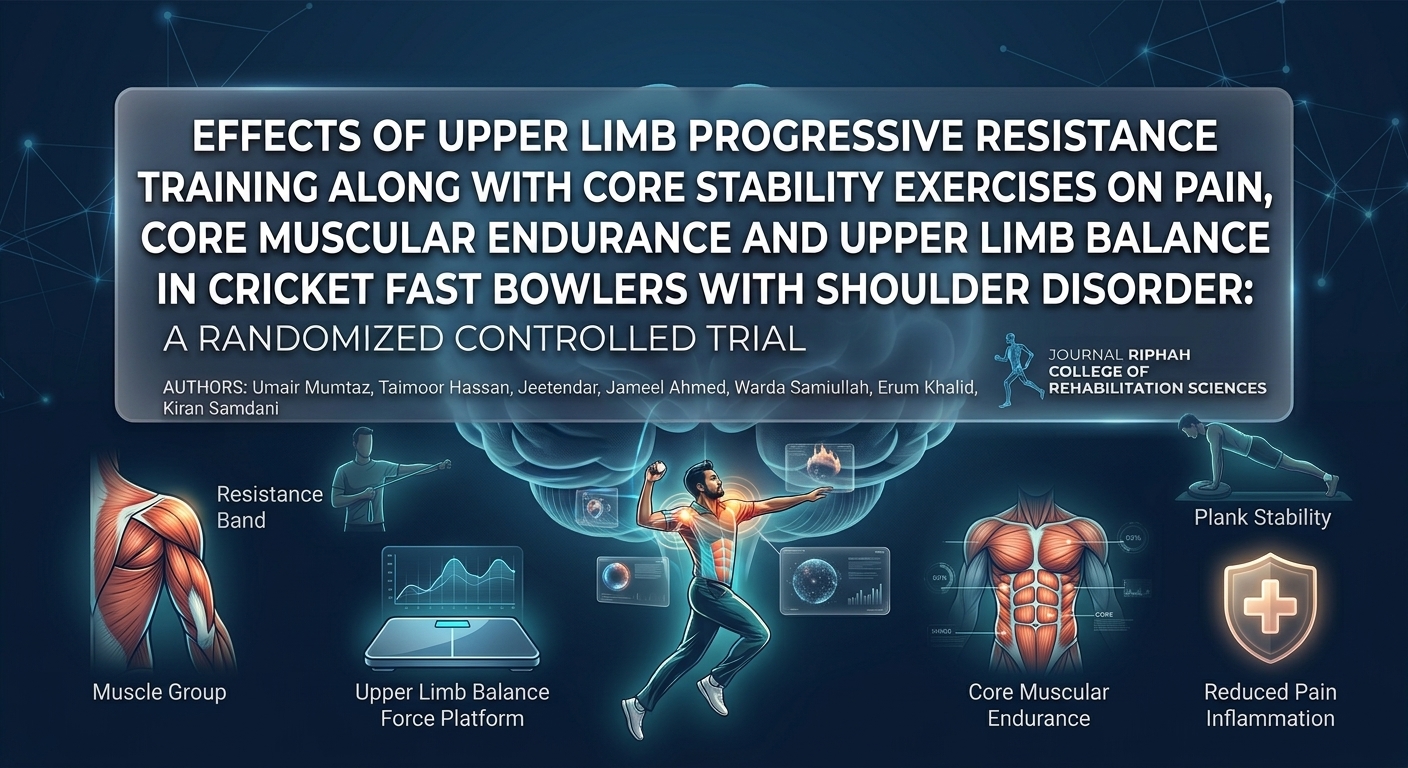
Background: Cricket fast bowlers are generous and particularly susceptible to shoulder problems due to the repetitive overhead movements they perform, and the substantial biomechanical stress associated with fast bowling. Shoulder disorders among them are normally associated with shoulder pain, poor core muscular endurance and some dysfunction in upper limb dynamic balance. Thus, it may be reasonable to expect that the integration of upper limb progressive resistance training and core stability training would be somewhat more comprehensive as a rehabilitation program and enhance functional performance.
Objective: To investigate the effect of the upper limb progressive resistance training with core stability on shoulder pain, core endurance, and upper limb dynamic balance in fast bowlers with shoulder disorders.
Methodology: Four-month randomized controlled trial (April-July 2025) at cricket clubs of Hyderabad and Jamshoro, Pakistan. Forty-eight male fast bowlers aged 18-35 years with shoulder disorders were divided randomly into two groups through the lottery method. Group A was exposed to a six-week intervention consisting of upper limb progressive resistance training with core stability exercises, whereas Group B only had progressive resistance training alone. The outcomes were measured both at baseline and post-intervention using the Visual Analog Scale (VAS), the Upper Quarter Y-Balance Test (UQYBT), and the plank endurance test. The statistics were performed using the Statistical Package for the Social Sciences (SPSS) version 23, and the level of significance was determined to be p<0.05. (ClinicalTrials.gov Registry No. NCT07055685)
Results: Significant improvements in pain, upper limb dynamic balance, and core muscular endurance were observed in both groups immediately after the intervention (p<0.05). Nevertheless, the combination of interventions group demonstrated significant decreases in pain, as well as increased upper limb dynamic balance and core muscular endurance, when compared to progressive resistance training group. In relation to the between group outcomes, there was a significant difference in all major outcome measures favoring the combined intervention group.
Conclusion: The study concluded that performing upper limb progressive resistance training in combination with core stability exercises is more beneficial than conducting only progressive resistance training regarding pain reduction and upper limb dynamic balance and core muscular endurance in fast bowlers with shoulder disorders.
Keywords: Core endurance, Fast-bowler, Resistance Training, Shoulder Disorders
References
Walter S, King D, Hume P. New Zealand cricket injury analysis based on 12 years of Accident Compensation Corporation data. BMJ Open Sport & Exercise Medicine. 2022 Aug 1;8(3):e001340.
Mathankar A, Kirti S. Strength and conditioning for cricket spin bowlers. Strength & Conditioning Journal. 2021 Dec 1;43(6):42-52.
Swart JJ. The effectiveness of exercise interventions to prevent shoulder injuries in sport: A systematic review and meta-analysis. PQDT-Global. 2021.
Shinde SB, Shah SP. Various Patterns of Spinal Muscle Imbalances in Shoulder Joint Dysfunction-A Systematic Review. International Journal of Natural Sciences. 2023;14(79):58035-45.
Sims K, Saw R, Saw AE, Kountouris A, Orchard JW. Multiple risk factors associated with lumbar bone stress injury in youth cricket fast bowlers. J Sport Exer Sci. 2021;5:92-100.
Bednar ED, Kay J, Memon M, Simunovic N, Purcell L, Ayeni OR. Diagnosis and management of little league shoulder: a systematic review. Orthopaedic Journal of Sports Medicine. 2021 Jul 28;9(7):23259671211017563.
Guirelli AR, Dos Santos JM, Cabral EM, Pinto JP, De Lima GA, Felicio LR. Relationship between upper limb physical performance tests and muscle strength of scapular, shoulder and spine stabilizers: A cross-sectional study. Journal of bodywork and movement therapies. 2021 Jul 1;27:612-9.
Lorusso M, Mastrangelo E, Garofalo G, Ristori D, Brindisino F. Diagnostic Accuracy of Physical Tests and Imaging Techniques in Patients with Shoulder Impingement Syndrome. Muscles, Ligaments & Tendons Journal (MLTJ). 2021 Jul 1;11(3).
Kara F, Gedik GE, Şahinoğlu E. The associations of physical parameters with the Closed Kinetic Chain Upper Extremity Stability Test, the Upper Quarter Y Balance Test, and the Upper Limb Rotation Test in professional overhead athletes. Physical therapy in sport. 2024 May 1;67:90-103.
Nimse A, Patel N, Pardiwala D. Criterion-based rehabilitation and return to play in fast bowlers following arthroscopic bankart repair: recommendations based on a detailed clinical review. Indian journal of orthopaedics. 2023 Oct;57(10):1565-74.
Sharif S, Ali MY, Kirazlı Y, Vlok I, Zygourakis C, Zileli M. Acute back pain: The role of medication, physical medicine and rehabilitation: WFNS spine committee recommendations. World Neurosurgery: X. 2024 Mar 6:100273.
Hawke B. Science of Swimming: Transform Your Stroke, Improve Strength, Revolutionize Your Training. Penguin; 2024 Dec 10.
Rudisill SS, Varady NH, Kucharik MP, Eberlin CT, Martin SD. Evidence-based hamstring injury prevention and risk factor management: A systematic review and meta-analysis of randomized controlled trials. The American journal of sports medicine. 2023 Jun;51(7):1927-42.
Escalante G, Fine D, Ashworth K, Kolber MJ. Progressive exercise strategies to mitigate shoulder injuries among weight-training participants. Strength & Conditioning Journal. 2021 Feb 1;43(1):72-85.
Olds M, Uhl T. Return to Sport Participation After Shoulder Injuries: A Physiotherapists’ Perspective. InSports Injuries 2025 (pp. 1207-1225). Springer, Cham.
Trybulski R, Michał W, Małgorzata S, Bogdański B, Bichowska-Pawęska M, Ryszkiel I, Gepfert M, Clemente FM. Impact of isolated lumbar extension strength training on reducing nonspecific low back pain, disability, and improving function: a systematic review and meta-analysis. Scientific reports. 2025 Feb 21;15(1):6426.
Hlaing SS, Puntumetakul R, Khine EE, Boucaut R. Effects of core stabilization exercise and strengthening exercise on proprioception, balance, muscle thickness and pain related outcomes in patients with subacute nonspecific low back pain: a randomized controlled trial. BMC musculoskeletal disorders. 2021 Dec;22:1-3.
Menek O, Aklar A, Alaca N, Subasi F. Do Core Stabilization Exercises Have an Impact on Pain, Posture, and Disability in Shoulder Impingement Syndrome? Gevher Nesibe Journal Of Medical And Health Sciences. 2025 Mar 9;10(1):69-81.
Schwank A, Blazey P, Asker M, Møller M, Hägglund M, Gard S, Skazalski C, Andersson SH, Horsley I, Whiteley R, Cools AM. 2022 Bern consensus statement on shoulder injury prevention, rehabilitation, and return to sport for athletes at all participation levels. journal of orthopaedic & sports physical therapy. 2022 Jan;52(1):11-28.
Shanahan ML, Rand KL, Galloway A, Matthias MS. Treatment goals and preferences of black veterans with chronic musculoskeletal pain. The Journal of Pain. 2024 Jul 1;25(7):104487.
Tauqeer S, Arooj A, Shakeel H. Effects of manual therapy in addition to stretching and strengthening exercises to improve scapular range of motion, functional capacity and pain in patients with shoulder impingement syndrome: a randomized controlled trial. BMC Musculoskeletal Disorders. 2024 Mar 2;25(1):192.
Alizadeh S, Daneshjoo A, Zahiri A, Anvar SH, Goudini R, Hicks JP, Konrad A, Behm DG. Resistance training induces improvements in range of motion: a systematic review and meta-analysis. Sports Medicine. 2023 Mar;53(3):707-22.
Dahl KS, van den Tillaar R. The effect of eight weeks of sling-based training with rotational core exercises on ball velocity in female team handball players. Journal of Human Kinetics. 2021 Jan 30;77:261.
Azizmohammadi S, Seidi F, Zandi S. Effect of a lumbopelvic stability training program on lower extremity kinematic parameters in low back pain developers during single-leg squat. Physical Therapy in Sport. 2025 Apr 22.
Zanjani B, Shojaedin SS, Abbasi H. “Investigating the combined effects of scapular-focused training and Mulligan mobilization on shoulder impingement syndrome” a three-arm pilot randomized controlled trial. BMC Musculoskeletal Disorders. 2024 Nov 8;25(1):897.
Feng T, Zhao C, Dong J, Xue Z, Cai F, Li X, Hu Z, Xue X. The effect of unaffected side resistance training on upper limb function reconstruction and prevention of sarcopenia in stroke patients: a randomized controlled trial. Scientific Reports. 2024 Oct 25;14(1):25330.
Nelson-Wong E, Crawley J, Cowell K, Parker L, Higgins E, Huang S, Lorbiecki C, Wood S. Effect of shoulder and hand position on sport-specific grip force in rock climbers. Sport J. 2023 Oct 20;24:850.
Downloads
Published
How to Cite
Issue
Section
License
Copyright (c) 2026 Open access article distributed under the terms of Creative Commons "Attribution-NonCommercial 4.0 International" license. https://creativecommons.org/licenses/by-nc/4.0/. Copyrights on any open access article published by Journal Riphah College of Rehabilitation Science (JRCRS) are retained by the author(s). The use, distribution or reproduction in other forums is permitted, provided the original author(s) and the copyright owner(s) are credited and that the original publication in this journal is cited, in accordance with accepted academic practice. No use, distribution or reproduction is permitted, which does not comply with these terms.

This work is licensed under a Creative Commons Attribution-NonCommercial 4.0 International License.